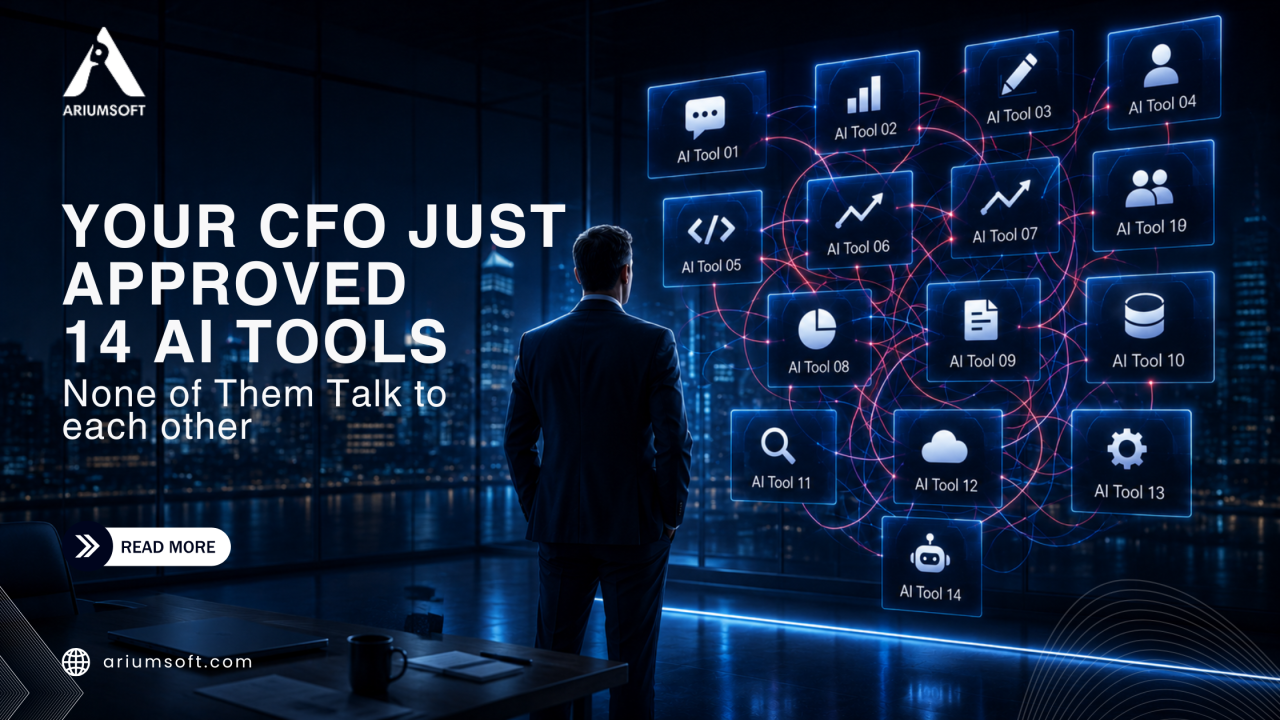
A founder I spoke with recently laughed when I asked how many AI tools his company was using.
"Honestly? I stopped counting."
First came an AI assistant for customer support. Then sales wanted something for lead research. Marketing picked up a content platform. Product teams started testing copilots. Operations brought in an analytics tool after seeing a demo that looked too good to ignore.
None of these purchases felt excessive at the time. Each one solved a real problem. But then he said something interesting.
"We've got AI everywhere now, but somehow we're spending more time managing software than before."
That comment stuck with me. It's becoming a common story and it doesn't get talked about nearly as much as the wins do.
Most software companies didn't wake up one morning and decide to build a stack of fifteen AI tools. It happened gradually.
Someone found a tool that saves a few hours every week. Another team heard about a platform from a peer. A vendor promised better forecasting. A department head pushed for a pilot after a good demo. One decision led to another, and months later the organization had a collection of AI products that were never really designed to work together.
That's where things start getting messy.
The support team has customer insights. Sales has customer insights. Marketing has customer insights. The product has customer insights. Yet when leadership asks for a complete picture, everyone shows up with different numbers not because anyone is wrong, but because everybody is looking through a different window.
Most executives know exactly how much they're spending on AI subscriptions. Those numbers are easy to find. What's harder to measure is the cost of friction.
Take a simple example. A customer repeatedly reports an issue through support. The product team sees unusual behavior in analytics. The account manager hears similar feedback during a renewal conversation. Three teams are dealing with the same problem, three systems contain relevant pieces of it, and nobody automatically connects the dots.
So employees do it manually. They compare reports, export data, sit through meetings that only exist because the systems can't talk to each other.
The monthly subscription fee might be a few hundred dollars. The hours lost every week are often worth far more.
There's a belief floating around that companies need to keep adding AI tools to stay competitive. You can understand why every week brings a new launch, a new feature, a new promise. It's easy to feel like you're falling behind.
But many leadership teams are discovering something unexpected. The problem isn't a lack of AI anymore. The problem is having too much of it running in isolation. At some point, adding another platform stops creating value and starts creating complexity. That's a difficult line to spot when every tool looks genuinely useful on its own.
Founders usually notice the issue first in product and engineering.
At the beginning, AI helps teams move faster. Then small things start appearing a workflow breaks because data isn't syncing correctly, a dashboard shows numbers that don't match another dashboard, a new feature requires three integrations before development can even begin.
Nothing feels catastrophic. It's just...slower. A little slower this month. A little slower next month. Until somebody realizes the roadmap isn't being delayed by product development it's being delayed by the growing effort required to keep systems pointed in the same direction.
Many organizations didn't anticipate this when they started investing. It's a different kind of problem than the ones AI was supposed to solve.
A year ago, the big question was: "Which AI tool should we adopt?"
Today, more leadership teams are asking: "How do we make everything we've already bought work together?"
That's a much more important conversation.
The companies seeing the biggest returns from AI aren't necessarily the ones with the largest budgets or the most tools. They're often the ones that have figured out how information moves across the business where customer data, operational data, product data, and AI-driven insights actually connect rather than sit in separate systems that don't speak to each other.
The next phase of AI adoption isn't about buying more. For many growing companies, it's about creating order from the collection they've already built. That's why AI architecture, integration, and system design are becoming boardroom discussions rather than purely technical ones. Companies like Ariumsoft are increasingly part of these conversations helping organisations connect scattered AI initiatives into something that feels less like a pile of subscriptions and more like a coherent strategy.
.avif)