What founders often discover after finding product-market fit.
Not every startup fails because it couldn't build a product.
Some struggle because they built the wrong first version.
A founder once told us,
"We did everything right. We launched in three months, got our first customers, even raised funding. Then suddenly, every new feature started taking longer than the last."
At first, they thought they needed more developers.
Then they blamed the tech stack.
Eventually, they realized the problem wasn't the team.
It was the foundation they had built the product on.
Ironically, success had exposed what failure never could.
When founders think about an MVP, the goal is usually clear:
Ship fast.
Validate the idea.
Get users.
Raise funding.
All of those things matter.
But there's another question that often gets ignored:
"What happens if this actually works?"
Because if your product finds traction, your MVP doesn't disappear.
It becomes the product your entire business grows on.
Every startup feels pressure to move quickly.
Investors want progress.
Customers want features.
Competitors aren't waiting.
So teams make trade-offs.
They hardcode workflows.
Skip documentation.
Ignore scalability.
Take shortcuts they promise to fix later.
Most of those decisions seem harmless when you have ten customers.
They feel very different when you have ten thousand.
The first few months are exciting.
New customers arrive.
The roadmap gets bigger.
The team grows.
Then something starts to feel different.
Simple features now require changes across multiple services.
Releases take longer.
Bugs become harder to trace.
Engineers spend more time understanding old code than writing new code.
The product didn't suddenly become bad.
It simply reached a stage the original architecture was never designed for.
When delivery starts slowing down, "technical debt" usually becomes the explanation.
Sometimes that's true.
But often, the bigger issue is that the MVP was never meant to support long-term growth.
It was built to prove an idea.
Not to support hundreds of customers.
Not to integrate AI.
Not to handle enterprise requirements.
Not to scale across regions.
There's nothing wrong with building fast.
The problem is assuming today's shortcuts won't become tomorrow's limitations.
The goal isn't to over-engineer your first release.
No startup should spend a year perfecting an MVP.
But there's a difference between building quickly and building carelessly.
The strongest engineering teams make deliberate decisions.
They keep the product simple.
They avoid unnecessary complexity.
But they also create a foundation that's flexible enough to grow with the business.
That balance is what separates products that evolve naturally from products that eventually need rebuilding.
One of the biggest misconceptions in startups is that rebuilding is a normal part of growth.
Sometimes it is.
Most of the time, it isn't.
The companies that scale smoothly aren't rewriting their platforms every twelve months.
They're improving them.
Adding capabilities.
Expanding into new markets.
Introducing AI where it creates real value.
Their architecture gives them options instead of creating obstacles.
That's a very different position to be in.
Founders often celebrate launching their MVP.
And they should.
Getting to market quickly is important.
But the real milestone isn't shipping version one.
It's reaching version fifty without wondering whether the whole platform needs to be rebuilt.
That's why more founders are thinking differently about product engineering.
They're asking not just,
"How quickly can we launch?"
But also,
"Will this product still support the business two years from now?"
At Ariumsoft, that's exactly how we approach product development. Whether we're building an AI-enabled MVP from scratch or modernizing an existing platform, the goal isn't simply to help teams launch faster. It's to build products with an architecture that can support growth, new capabilities, and future AI adoption without forcing businesses back to square one.
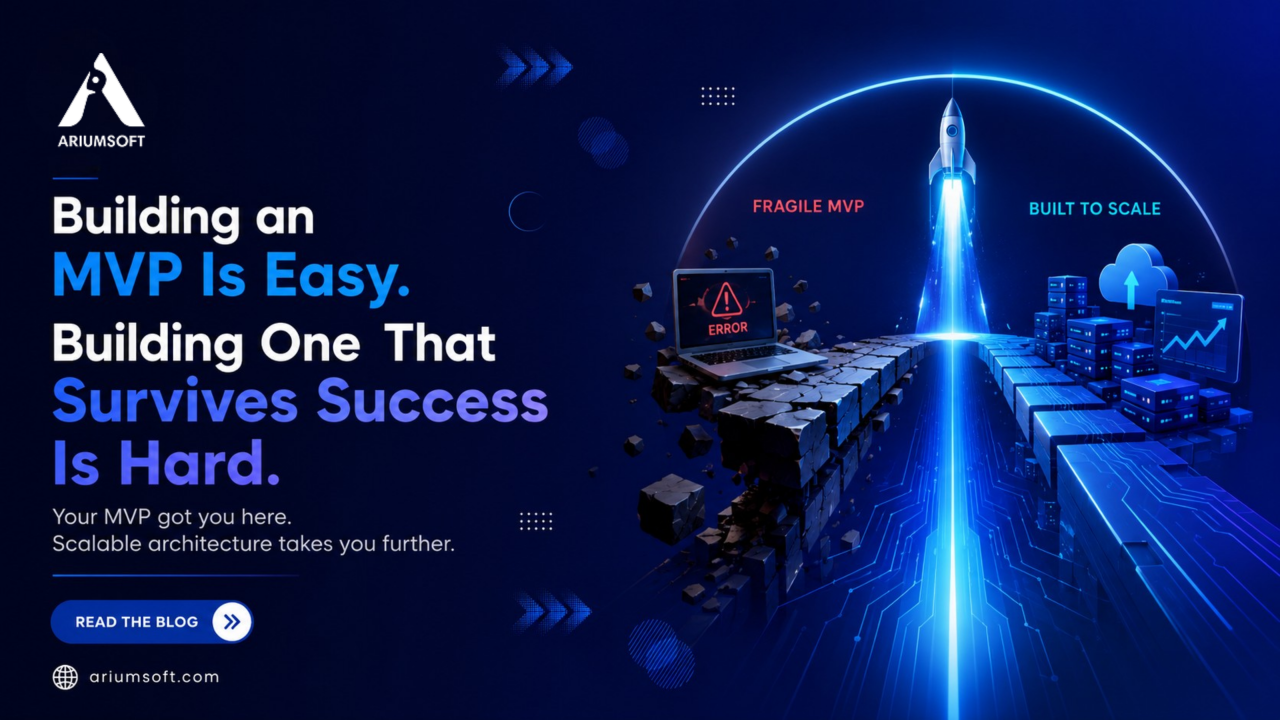
Because building an MVP is only the beginning.
Building one that survives success—that's the real challenge.
Enjoyed this article?
Follow the Ariumsoft Engineering Insights newsletter on LinkedIn for practical insights on product engineering, AI, cloud architecture, and building software that scales.
.avif)