Why AI investments are not paying back—and what changes when AI is built into the architecture, not bolted onto it.
Not long ago, almost every boardroom was having the same conversation:
"What's our AI strategy?"
There was pressure from every direction.
Investors wanted to hear it.
Customers started expecting it.
Competitors could not stop announcing new AI features.
Nobody wanted to be the company that looked like it had missed the biggest technology shift in years.
So every company moved.
Some gave developers AI coding assistants.
Others rolled out AI for customer support, sales, reporting, or internal knowledge management.
The speed of adoption was incredible.
For a while, just having AI somewhere in the business felt like a win.
Fast forward a year, and the conversation has changed.
Few leadership teams are asking whether they should invest in AI.
Instead, they are asking something harder:
"We've spent the money. So why doesn't it feel like the business has changed?"
It's a question more companies are wrestling with than most people realize.
One thing has become pretty obvious over the last year:
Putting AI into a business and getting business value from it are two completely different things.
Most companies do not have a shortage of AI tools.
The engineering team has one.
The marketing team has another.
The sales team has its own.
The support team has theirs.
Individually, they all do what they are supposed to do.
Collectively, not much has changed.
Teams still jump between systems.
Information still lives in silos.
Projects still take longer than expected.
Customers still experience bottlenecks.
The AI works.
The business often carries on exactly as before.
When an AI initiative does not deliver, the first instinct is usually to question the technology.
Maybe the prompts were not good enough.
Maybe a different model would have worked better.
Maybe next year's version will finally live up to the hype.
In reality, that's rarely where things go wrong.
Most AI projects inherit the problems the business already had:
AI does not magically fix those things.
It simply has to operate around them.
Eventually, those same problems limit what AI can actually achieve.
Over the last year, several industry reports have pointed to the same trend:
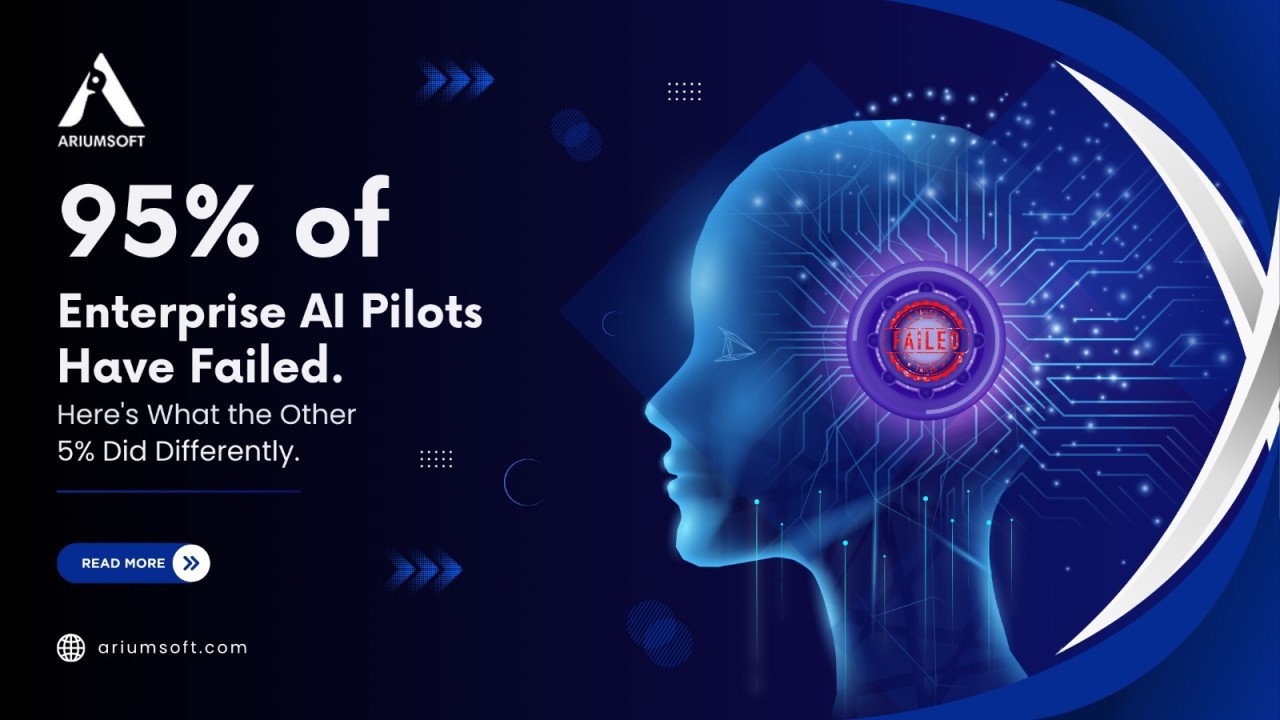
A large percentage of enterprise AI pilots never move beyond experimentation or deliver the return companies expected.
At first, those numbers seem surprising.
The more you look at them, the less surprising they become.
Most businesses spent the last two years figuring out where they could add AI.
Far fewer asked whether their products, data, and engineering foundations were actually ready for it.
Those are two very different conversations.
The businesses getting real results from AI are not necessarily using better models.
Most of them simply laid the groundwork first.
Their systems talk to each other.
Their data is cleaner.
Their engineering teams know where AI genuinely adds value—and where it does not.
Because of that, AI becomes part of the product instead of another tool employees have to switch to.
Every new capability builds on the last one.
Instead of creating more complexity, it removes it.
That's where real ROI starts to appear.
It's easy to think of AI as another feature on the roadmap.
In reality, it's much closer to another layer of your architecture.
Every recommendation depends on data.
Every intelligent workflow depends on systems.
Every AI-driven decision depends on the quality of the business logic underneath it.
If those foundations are weak, AI exposes the cracks faster.
If they're strong, every improvement becomes easier to build.
That's why some companies keep expanding their AI capabilities while others quietly move on from pilot after pilot.
The difference usually is not budget.
It is not the model.
More often than not, it's the architecture.
Twelve months ago, the conversation was simple:
"Where can we add AI?"
Now it's becoming more practical:
"Is our product actually ready for AI?"
That's a much better question.
Because the biggest return on AI does not come from buying another tool.
It comes from building products where AI naturally improves customer experience, simplifies operations, and continues creating value as the business grows.
That's a challenge.
It's also where the biggest competitive advantage is starting to emerge.
AI models will keep improving.
Next year's models will almost certainly be faster and more capable than today's.
Almost everyone will have access to them.
That's why access to AI itself will not be what separates companies from everyone else.
What will separate them is how well they've prepared their products to make use of it.
That's why more founders and technology leaders are spending less time comparing AI models and more time evaluating their architecture.
The teams we work with at Ariumsoft often come to the same realization.
Whether they're building an AI-enabled MVP, introducing AI into an existing platform, or assessing how ready their product is for long-term AI adoption, the biggest gains rarely come from adding another AI feature.
They come from building a product that's ready to support AI from the ground up.
Because in 2026, almost everyone can access AI.
Very few have built a product that's truly ready for it.
.avif)